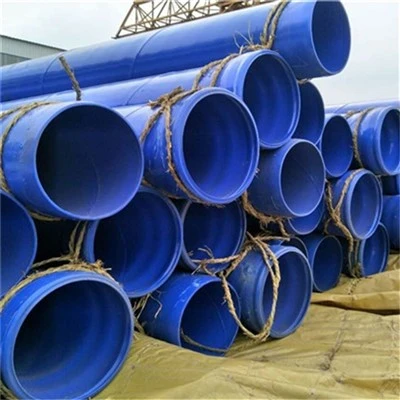
Anti-corrosion steel pipes are an indispensable material in modern industry and infrastructure construction. The quality of their forming process directly determines their service life and safety performance. As the corrosion resistance requirements for pipelines in the oil, gas, chemical, and municipal engineering sectors continue to increase, the manufacturing technology for anti-corrosion steel pipes is also undergoing continuous innovation. This article will delve into the core forming process for anti-corrosion steel pipes, providing a comprehensive analysis of the production process from basic processes to key technical details.
I. Basic Forming Principles of Anti-corrosion Steel Pipes
Anti-corrosion steel pipes essentially consist of a standard steel pipe substrate coated with one or more layers of anti-corrosion material through a specific process, forming a composite structure of "base material + anti-corrosion layer." The core objective of this forming process is to ensure the mechanical properties of the steel pipe (such as compressive and impact resistance) while precisely controlling the adhesion, thickness uniformity, and chemical stability of the anti-corrosion layer to achieve long-term protection for the pipe in complex environments (such as high humidity, strong acids, alkalis, and salt spray).
Traditional steel pipe forming typically relies on a "rolling + welding" process-a steel billet is hot-rolled or cold-rolled into a tubular blank, which is then welded or submerged-arc welded to form a continuous pipe body. Anti-corrosion technology builds upon this foundation, imparting additional corrosion resistance to the steel pipe through surface treatment, coating, or cladding.

II. Detailed Explanation of Core Forming Process Steps
1. Base Pipe Pretreatment: Cleaning and Shaping
The bond strength between the anti-corrosion layer and the steel pipe is directly dependent on the cleanliness and roughness of the base pipe surface. If residual oil, rust, or scale remain on the surface, the anti-corrosion material will not adhere effectively, leading to subsequent problems such as bulging and peeling. Therefore, pretreatment is the first critical step in the forming process.
Specific operations include:
Mechanical rust removal: Shot blasting or sandblasting equipment uses high-speed steel shot or quartz sand to impact the steel pipe surface, removing scale and creating a uniform rough surface (typically requiring an anchor mark depth of 40-100μm).
Chemical cleaning: Organic solvents (such as acetone) or acid-base solutions (such as phosphoric acid) are used to remove residual grease and minor rust, ensuring the surface is free of visible contaminants.
Drying: Hot air or infrared drying is used to control the surface moisture of the steel pipe to an extremely low level (humidity <5%) to prevent bubbles during subsequent coating.
2. Anti-corrosion layer forming: comparison of mainstream processes
Based on the type of anti-corrosion material and the application scenario, the forming process of anti-corrosion steel pipes can be divided into three major directions:
(1) Three-layer polyethylene (3PE) anti-corrosion - the most widely used process
3PE anti-corrosion is a composite structure of "fusion bonded epoxy powder (FBE) bottom layer + adhesive middle layer + polyethylene outer layer". It combines the high adhesion of epoxy powder with the environmental stress cracking resistance of polyethylene, and is suitable for harsh environments such as buried oil and gas pipelines. The molding process is as follows:
Base coating: Electrostatically spray the fused epoxy powder (particle size ≤ 150 μm) evenly onto the pre-treated steel pipe surface, and then melt and solidify it at a high temperature of 200-230°C to form a dense epoxy layer with a thickness of about 50-100 μm;
Intermediate layer coating: The adhesive (such as modified polyethylene copolymer) is heated to a molten state (about 250°C) by an extruder, and then evenly coated on the outside of the epoxy layer through a mold, with a thickness of about 170-250 μm;
Outer layer extrusion: High-density polyethylene (HDPE) is also melted and coated through an extruder to form an outer protective layer with a thickness of 1.8-3.7 mm (resistant to ultraviolet rays and mechanical damage).
(2) Epoxy coal tar anti-corrosion - suitable for small and medium-sized diameter pipelines
This process uses epoxy resin and coal tar pitch as the main raw materials, and forms an anti-corrosion layer on the surface of the steel pipe by brushing or dipping. Its characteristics are low cost, but it is sensitive to the construction environment temperature (needs to be greater than 5°C) and humidity, and is often used for water supply and drainage pipes or temporary projects.
(3) Cement mortar lining - a supplementary solution for special scenarios
For low-pressure pipelines that transport non-corrosive media (such as drinking water), a centrifugal spraying method can be used to evenly adhere cement mortar (water-cement ratio 0.4-0.5) to the inner wall of the steel pipe to form a lining layer with a thickness of 10-30mm. This process is low-cost and wear-resistant, but has weak resistance to chemical corrosion.
3. Post-Processing and Testing: Ensuring Forming Quality
After forming, the anti-corrosion coating undergoes rigorous quality control:
Thickness Testing: Measure the thickness of each layer using a magnetic or ultrasonic thickness gauge (e.g., for 3PE anti-corrosion coating, the epoxy layer must be ≥80μm, and the polyethylene layer must be ≥2mm).
Adhesion Testing: Verify the bond strength between the anti-corrosion coating and the steel pipe using the cross-hatch or pull-off method (typically requiring ≥5MPa).
Electric Spark Detection: Scan the surface of the anti-corrosion coating with a high-frequency, high-voltage probe to detect pinholes or damage (leak point voltage ≥25kV).
Appearance Inspection: Verify the absence of defects such as bubbles, cracks, and sags, ensuring a smooth and even surface.
III. Process Innovation and Future Trends
With the escalation of industrial demand, the forming process for corrosion-resistant steel pipes is evolving towards higher efficiency, intelligent technology, and environmental friendliness:
Promotion of prefabrication: Continuous production lines integrate "steel pipe rolling, pretreatment, and anti-corrosion coating," shortening production cycles and improving consistency;
Development of new anti-corrosion materials: Applications such as nano-modified epoxy powder and graphene-enhanced polyethylene further extend the corrosion life (up to 50 years or more);
Exploration of green processes: Reducing the use of organic solvents (e.g., replacing traditional solvent-based coatings with water-based epoxy coatings) reduces VOC emissions.
Conclusion
The forming process for corrosion-resistant steel pipes is a culmination of the intersection of materials science, mechanical manufacturing, and chemical engineering. From base pipe pretreatment to precise application of the anti-corrosion coating, every step requires rigorous control of parameters and details. With continuous technological advancements, future corrosion-resistant steel pipes will not only meet the basic requirement of corrosion resistance but also achieve breakthroughs in intelligent monitoring (such as built-in corrosion sensors) and lightweight design, providing more reliable support for global infrastructure construction.