


As a supplier of steel spiral pipes, I've witnessed firsthand the crucial role that the modulus of elasticity plays in determining the deformation behavior of these pipes under load. The modulus of elasticity, often denoted as E, is a fundamental material property that measures the stiffness of a material. It represents the ratio of stress to strain within the elastic range of a material, indicating how much a material will deform under a given load.

Understanding the Modulus of Elasticity
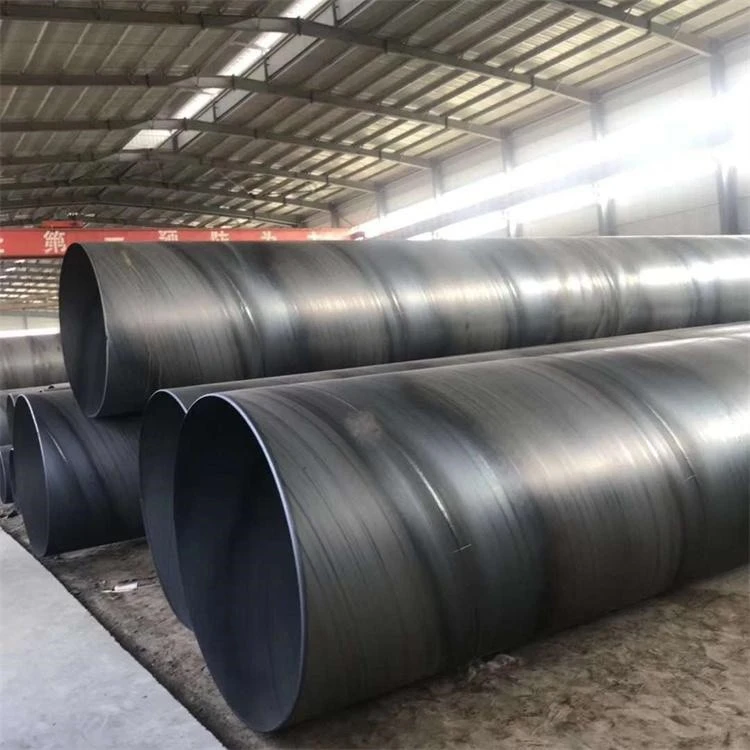
The modulus of elasticity is a key parameter in engineering design, as it provides valuable insights into how a material will respond to external forces. For steel spiral pipes, which are commonly used in various applications such as Spiral Steel Pipe for Piling Pipe, Dredge Spiral Steel Pipe, and Double-sided Submerged Arc Welding Spiral Steel Pipe, understanding the influence of the modulus of elasticity on deformation behavior is essential for ensuring structural integrity and performance.
Steel is known for its high modulus of elasticity, typically ranging from 200 to 210 GPa. This high stiffness allows steel spiral pipes to withstand significant loads without excessive deformation. When a load is applied to a steel spiral pipe, the pipe will initially deform elastically, meaning that it will return to its original shape once the load is removed. The modulus of elasticity determines the relationship between the applied stress and the resulting strain within this elastic range.
Influence on Deformation Behavior
The modulus of elasticity has a direct impact on the deformation behavior of steel spiral pipes under load. A higher modulus of elasticity indicates a stiffer material, which means that the pipe will deform less under a given load. This is particularly important in applications where precise dimensions and minimal deformation are required, such as in structural support systems or fluid transportation pipelines.
In the case of axial loading, the modulus of elasticity affects the amount of axial deformation or elongation that the pipe will experience. According to Hooke's Law, the axial strain (ε) is directly proportional to the axial stress (σ) and inversely proportional to the modulus of elasticity (E):
ε = σ / E
This means that for a given axial stress, a pipe with a higher modulus of elasticity will have a lower axial strain and therefore less axial deformation. In practical terms, this translates to better dimensional stability and reduced risk of failure due to excessive deformation.
Similarly, in the case of bending loading, the modulus of elasticity influences the amount of bending deflection that the pipe will undergo. The bending deflection of a pipe is directly related to its stiffness, which is determined by the modulus of elasticity and the moment of inertia of the pipe cross-section. A higher modulus of elasticity results in a stiffer pipe, which will experience less bending deflection under a given bending moment.
Impact on Structural Performance
The influence of the modulus of elasticity on deformation behavior also has significant implications for the structural performance of steel spiral pipes. Excessive deformation can lead to a variety of problems, including reduced load-carrying capacity, increased stress concentrations, and potential failure of the pipe. By understanding and controlling the modulus of elasticity, engineers can design steel spiral pipes that are capable of withstanding the expected loads without compromising structural integrity.
In addition to its impact on deformation behavior, the modulus of elasticity also affects other important mechanical properties of steel spiral pipes, such as strength and fatigue resistance. A higher modulus of elasticity generally corresponds to a higher yield strength and ultimate tensile strength, which means that the pipe can withstand higher loads before reaching its yield point or failing. Furthermore, a stiffer pipe is less likely to experience fatigue failure, as it will undergo less cyclic deformation under repeated loading.
Factors Affecting the Modulus of Elasticity
The modulus of elasticity of steel spiral pipes can be influenced by several factors, including the chemical composition of the steel, the manufacturing process, and the heat treatment. Different grades of steel have different chemical compositions, which can affect the modulus of elasticity. For example, steels with higher carbon content or alloying elements such as manganese, chromium, or nickel may have a higher modulus of elasticity.
The manufacturing process also plays a role in determining the modulus of elasticity. Steel spiral pipes are typically manufactured using a continuous welding process, which can introduce residual stresses and affect the microstructure of the steel. These residual stresses and microstructural changes can influence the modulus of elasticity and other mechanical properties of the pipe. Heat treatment processes, such as annealing or quenching and tempering, can be used to modify the microstructure of the steel and improve its mechanical properties, including the modulus of elasticity.
Considerations in Design and Selection
When designing and selecting steel spiral pipes for a specific application, it is important to consider the influence of the modulus of elasticity on deformation behavior. Engineers should carefully evaluate the expected loads, the required dimensional tolerances, and the operating conditions to determine the appropriate modulus of elasticity for the pipe. In some cases, it may be necessary to select a higher modulus of elasticity to ensure minimal deformation and maintain structural integrity.
It is also important to note that the modulus of elasticity is just one of many factors that should be considered in the design and selection process. Other factors, such as strength, ductility, corrosion resistance, and cost, should also be taken into account to ensure that the selected pipe meets the specific requirements of the application.
Conclusion
In conclusion, the modulus of elasticity plays a crucial role in determining the deformation behavior of steel spiral pipes under load. A higher modulus of elasticity results in a stiffer pipe, which experiences less deformation under a given load. This has significant implications for the structural performance, dimensional stability, and overall reliability of steel spiral pipes in various applications.
As a supplier of steel spiral pipes, we understand the importance of providing high-quality products that meet the specific requirements of our customers. By carefully controlling the modulus of elasticity and other mechanical properties of our pipes, we can ensure that they are capable of withstanding the expected loads and providing long-term performance.
If you are in need of steel spiral pipes for your next project, we invite you to contact us to discuss your specific requirements. Our team of experts will be happy to assist you in selecting the right pipe for your application and providing you with the best possible solution.
References
- Budynas, R. G., & Nisbett, J. K. (2011). Shigley's Mechanical Engineering Design. McGraw-Hill.
- Calladine, C. R. (2000). Principles of Structural Mechanics. Cambridge University Press.
- Timoshenko, S. P., & Goodier, J. N. (1970). Theory of Elasticity. McGraw-Hill.


